

ⒾMachine translation by Deepl
A well-timed surprise
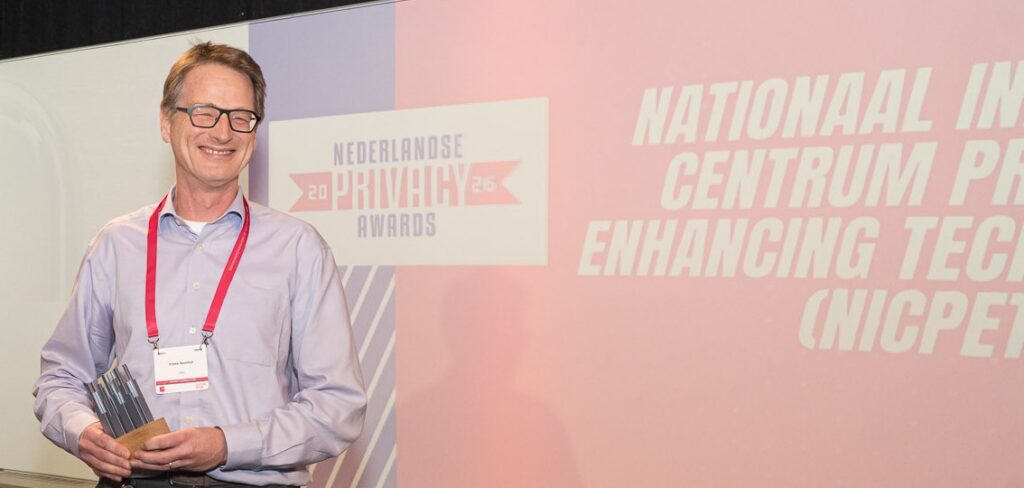
Freek Bomhof on the Incentive Award for the National Innovation Centre for Privacy-Enhancing Technologies (Nicpet).
In the eight months since winning the Award, a great deal has happened at Nicpet. Jury members Sulaika Duijsings-Mahangi and Koen Versmissen learnt this during a lively conversation with the driving force behind the project, Freek Bomhof (TNO).
I never expected it
“It’s actually quite funny”, laughs Freek, “Organisations from our membership base had already been nominated on several occasions, and some of them had even won a Dutch Privacy Award, but it never occurred to us that we might win an award ourselves.” Even when it was made clear to him that he really had to make sure he attended the National Privacy Conference – the event at which the Privacy Awards are presented each year – it still didn’t really click. It came as a great surprise, then, when it turned out that he was to represent Nicpet at the Incentive Award was able to accept.
Good timing
Whilst Nicpet had no idea it would win the prize, the jury, for their part, had no idea just how well-timed it was. Bomhof: “We were at a turning point at the time, because our funding was running out. We were seriously considering pulling the plug at that point. But of course, you can’t really do that when you’ve just won an award like that.” With renewed vigour, Nicpet successfully sought new funding both within TNO and amongst its supporters: funding is secured at least until some time in 2027.
Transition
Nicpet is a typical example of an initiative that aims to make itself redundant. But we’re not quite there yet. The next step will therefore follow shortly: applying for a “scaling-up ticket” within the generic digital infrastructure. This would enable Nicpet to make the transition from being a catalyst that helps drive specific cases forward – important but also time-consuming work – to becoming a developer of generically applicable components that enable implementing organisations to handle sensitive data responsibly. Incidentally, this is more complicated than it sounds: it is not just about the technology, but also about standardisation and legal framework.
AI
The day before the interview, seven government organisations issued an urgent appeal: AI makes hacking so much easier that cybersecurity is a matter of urgency A matter for senior management should be. Can Privacy Enhancing Technologies (PETs) help to tackle the new threats? Bomhof: “Absolutely. You can’t leak data you don’t have. It’s not a quick fix, but it can certainly help.” And AI raises many more privacy issues, as Bomhof is aware; he is also involved in GPT-NL, and so actually won two Privacy Awards last year. It turns out that removing personal data from training data is incredibly complicated, and that AI is not only adept at hacking but also very good at re-identifying anonymised data. These are issues for the Privacy Awards jury to monitor closely.
Wallets
Apart from PETs and AI, are there any other developments the jury should keep an eye on? After some thought, Bomhof settles on privacy-friendly wallets, such as Yivi. That won – then known as IRMA – won the very first Dutch Privacy Award in 2018. It’s technically impressive, but consumers still aren’t finding their way there in sufficient numbers. That is precisely why a Privacy Award would be a great boost.
A helping hand
Finally, Bomhof once again emphasises the encouraging effect of the Privacy Awards. Throughout his career, he has regularly faced setbacks, had good ideas that were ahead of their time, and wondered whether he was on the right track. So it’s wonderful when an organisation with no vested interest says: “Well done!” When doubt strikes again, you can look at that trophy and decide to carry on after all.
