ⒾMachine translations by Deepl
Privacy as a cornerstone
Michel Jochems on the Privacy Award and the Quality Mark for Journey Recording Systems
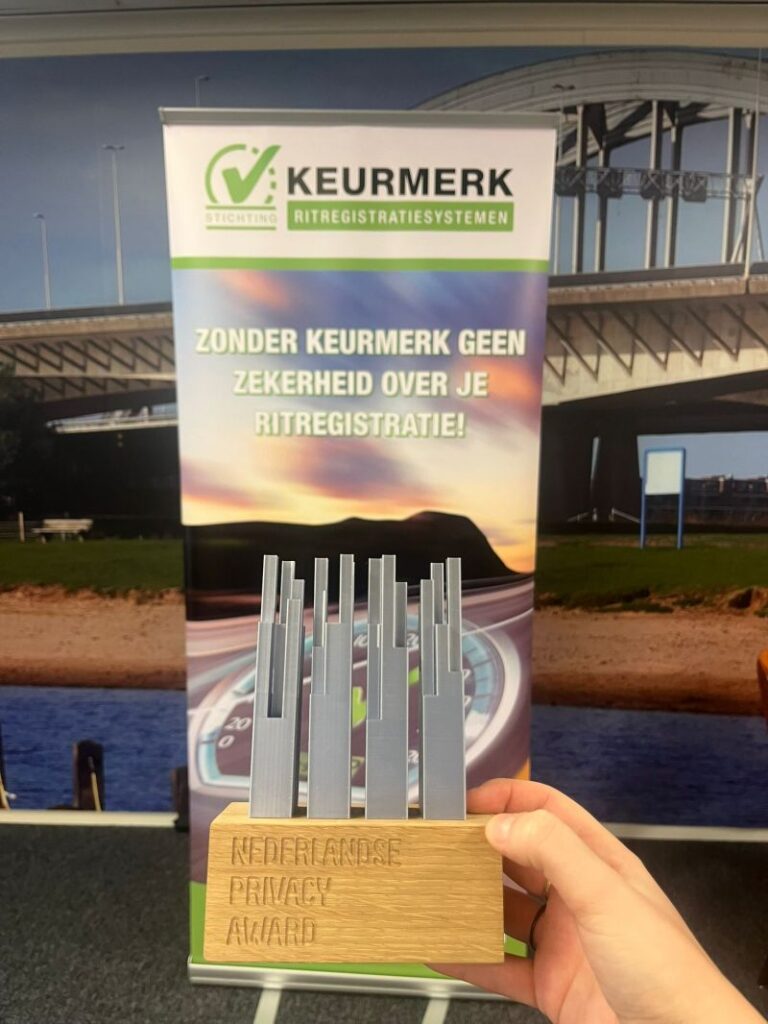
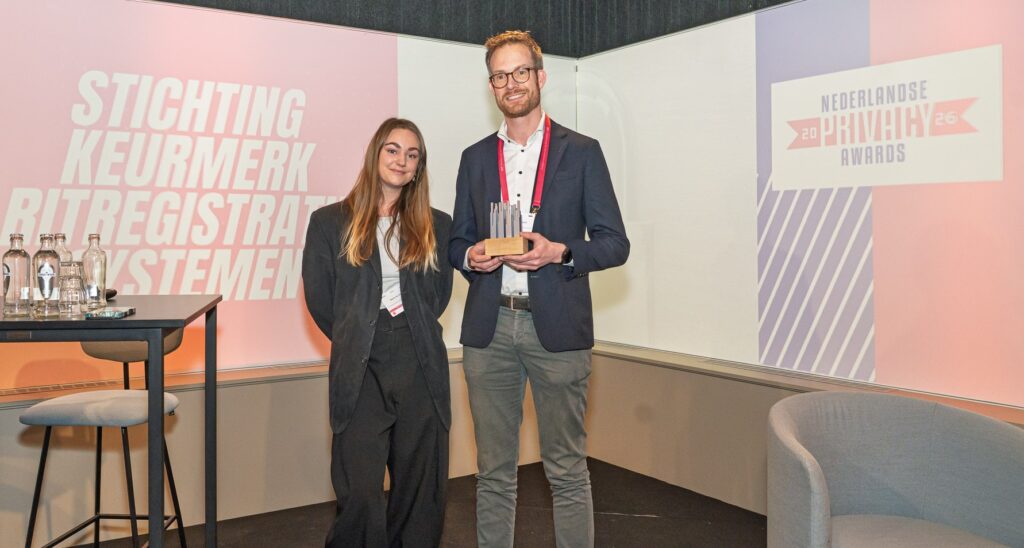
A few months after the Dutch Privacy Awards ceremony, jury members Sah Farooq and Marlon Domingus spoke with Michel Jochems, who works for the Foundation for the Quality Mark for Journey Recording Systems (SKRRS). In an open and enthusiastic conversation, Michel looks back on what the recognition has meant a great deal to the foundation, to its member suppliers and, last but not least, to the drivers who are out on the road every day using a journey-logging system.
A testament to years of hard work
“For us, it was a truly wonderful moment in any case. I’m not sure if ‘reassurance’ is the right word, but above all it felt like a wonderful confirmation of what we, as a foundation, have been working on for years: safeguarding privacy within the journey-logging system.” This recognition is not felt solely within the foundation itself. According to Michel, the award of the Dutch Privacy Award also has a positive impact on the twenty-five suppliers that carry the quality mark — which together account for an estimated 80 per cent of the Dutch market. “Generally speaking, you can see that suppliers are simply reaping the benefits of this, both in terms of their commercial activities and in relation to their existing customers.”
People often say: a quality mark – what’s it actually worth? Well, it’s worth a great deal. We’ve simply got things well organised, and we make sure we keep working well together.
From a ‘Wild West’ approach to a shared foundation
The quality mark may have been formally established in August 2013, but the first discussions between market participants and the Tax and Customs Administration had begun years before that. Michel takes us back to the very beginnings. “Back then, the market for journey-logging systems was a bit like the Wild West. Some suppliers simply wanted to do things properly and in accordance with the law, whilst others offered fraud options within their systems and even boasted about them in discussions with customers.”
A number of reputable suppliers felt that this was not a good idea. “That’s not what we should be competing over”, Michel recalls. “We wanted to make sure we were doing the right thing: ensuring ease of use for the customer, whilst still complying fully with the law.” Those suppliers themselves entered into discussions with the tax authorities, which ultimately led to a set of standards and an audit file that were approved by the tax authorities — the basis of the current quality mark.
However, as Michel explains, one key perspective was missing from those early discussions: that of the driver themselves. It was the Association of Business Drivers (VZR), one of the foundation’s “founding fathers”, that changed that. “He said: ”Look, it’s all very well, but we mustn’t forget to take the rider’s interests and privacy into account as well.’” The way in which journey logs were checked at the time — in the association’s words, “a bit black-and-white, a bit rigid” — also called for a more privacy-conscious alternative. That realisation forms the basis of a core principle within the quality mark: when assessing the 500-kilometre limit for private use, it is the total number of kilometres that matters, not where someone has driven to for private purposes. “Private mileage is private mileage. So why should you have to provide details of the route? That’s not necessary.” It is, as Michel puts it, a deliberate choice that goes even further than the letter of the law — with the Tax and Customs Administration’s approval.
The locker: striking a balance between the rider and the employer
Michel explains what privacy actually means within a journey-recording system, using an analogy that is now well known within the sector: the safe. “The quality mark ensures the right balance”, he says. If someone is delivering parcels for a company, the employer must be able to see where that person is driving, for example to schedule an urgent job in between. If it’s a private journey, however, the balance must be the other way round: “It is none of the employer’s business what happens to that vehicle in a private context.”
Nevertheless, private journeys must also be recorded in detail — in case a journey turns out to have been a business journey after the event. To resolve this without compromising the driver’s privacy, a sort of ‘safe’ has been set up within the system. “Only the rider has the key to that. If a journey has been incorrectly marked as private, only the rider can change it to business and retrieve the relevant details from the locker.” This ensures that the journey records remain accurate, without the employer ever gaining any insight into where an employee has been in their private time.
Constantly evolving
According to Michel, what sets the foundation apart is that privacy is not a static issue. A participants’ council and a standards committee constantly monitor whether the quality mark remains in line with new technological and societal developments. The Self-Assessment, which now comprises 103 standards – of which around 35 relate directly or indirectly to privacy – is regularly reviewed.
One tangible result of this ongoing refinement is the recent change to the mandatory reporting requirements to the Tax and Customs Administration. Whereas suppliers were previously required to use the BSN number as a linking mechanism, that number has now been removed. “That was a strict requirement imposed by the tax authorities, and we had a great many discussions about it”, says Michel. “In the end, we said: let’s please stop using that BSN number – it involves sensitive personal data. We don’t want that anymore.” A different type of unique identifier, known to the employer, was returned, without the use of the BSN number. “Thirteen years ago, this wasn’t even up for discussion. Today, it’s an absolute no-go.”
New developments too – such as vehicles that are collecting ever more data themselves and the rise of AI in software development – are keeping the foundation on its toes. Michel takes a level-headed view of both the opportunities and the areas requiring attention.
On the subject of vehicle data that manufacturers will be required to make available in future, he says: “We have discovered that the quality of that data is not yet high enough to meet the standards of the quality mark. And we also do not have a clear enough picture of what happens to that data before it is made available to the market.” Until such transparency is in place, the foundation will, for the time being, continue to use its own, tried-and-tested system.
Privacy must be woven into the very fabric of your business — into what you do and how you choose to organise it. It’s not just for show. It is, quite literally, privacy by design.
Looking ahead to 2030
Michel looks to the future from three perspectives: development, auditing and communication. In the area of development, the set of 103 standards is updated periodically, but preferably in a series of coherent steps rather than through annual revisions; “Otherwise, we’ll be relying too often on our suppliers” development capacity, and they’re simply commercial enterprises that need to make a profit.”
When it comes to auditing, the foundation deliberately looks for more than just a tick-box exercise: the auditors also contribute their expertise and best practices … which, according to Michel, leads to fruitful discussions.
And in the field of communication, the foundation is working on a vision for 2030, including by responding proactively to calls for tenders and positioning the quality mark more clearly in relation to, for example, ISO 27001, with which it is regularly – though incorrectly – confused. “The quality mark is all about keeping accurate journey records. Privacy is a very important aspect of this, as is information security. We still have work to do on our public image in this regard — and we’re keeping that very much in mind.”
A word of advice for future participants
At the end of the interview, Michel looks back on the Privacy Award process itself, including the pitch that the nominated entrants had to give. “At the start, it wasn’t entirely clear what the process would involve. We were given the opportunity to write a well-structured essay, complemented by a ”Dragons’ Den’-style presentation delivered live to the full jury. But that helped us enormously – not only in helping us clarify exactly what we stand for, but also in taking our ideas to the next level.” That enthusiasm carried over to the board and even reached the Tax and Customs Administration.
Michel advises organisations considering entering the Privacy Award that it is primarily about striking a balance between genuine intention and being able to demonstrate that to the outside world. “In recent years, privacy has become an issue that has attracted an incredible amount of attention, and one that really requires people’s trust. It’s not just about wanting to do the right thing as an organisation. It’s also about being able to assure your customers and your target audience that you’ve actually got it right.”
We found this process to be very valuable, even if we hadn’t won.
As far as that participation is concerned, Michel is clear: the process was worthwhile, regardless of the outcome. The Privacy Award has now proved to be a lasting, positive force for the foundation, its suppliers and the many drivers who, every day, on a privacy-compliant trust in the journey recording system.